

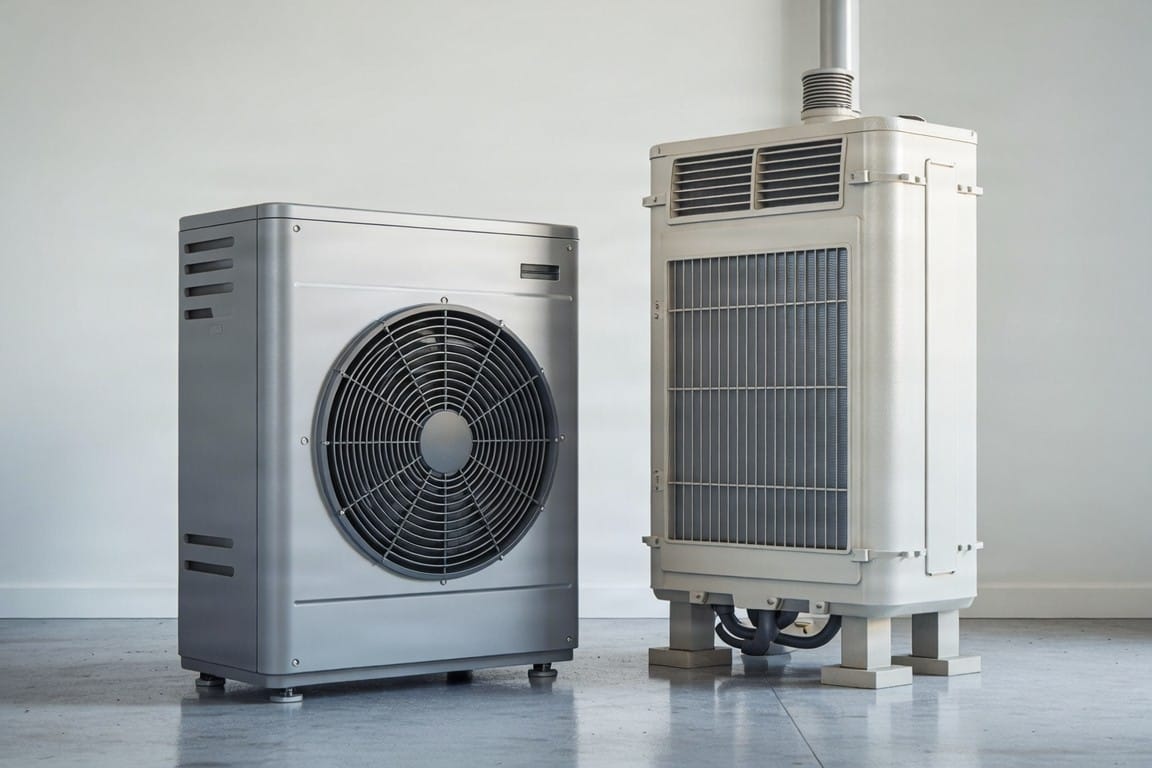
In Winnipeg, we recommend gas furnaces for most homeowners; even the best heat pumps cannot handle the coldest days we see here. For eco-conscious homeowners, we recommend a heat pump with a gas furnace or an electric furnace backup!
Key Takeaways
- Heat pumps can handle weather up to around -30°C.
- In Winnipeg, homeowners need a furnace to back up their heat pump.
- Gas furnaces are the most cost-effective furnaces over time.
- Heat pumps are the most fuel-efficient heating source for most homes.
- Heat pumps are safer and more eco-friendly than gas furnaces.
- There are rebates available for heat pumps in Winnipeg.
Region As The Most Important Factor
Traditionally, the region you live in has been the deciding factor when choosing between a heat pump and a natural gas furnace. For reasons you’ll learn as you read this article, heat pumps are incredibly efficient at heating your home when the air outside is cool – but less efficient when it’s 40 below.
In areas like Winnipeg, this has been the number one reason to choose a gas furnace over a heat pump. Fortunately, modern air pumps are much more efficient – even when it gets very cold outside – and you can run them for most of the season, even in Winnipeg. You’ll still need a gas furnace as backup, though!
What Is A Gas Furnace?
A gas furnace burns natural gas as its primary fuel source; this contrasts with electric furnaces (that use electricity to power heating elements) and oil furnaces (that use oil as a fuel source). Gas furnaces are the most popular type of furnace in Manitoba.
Advantages Of A Gas Furnace
Gas furnaces are incredibly good at heating homes, and here in Manitoba, natural gas is very affordable. Thanks to the efficiency of gas as a fuel source, running a gas furnace is much more cost-effective than running an electric furnace, despite Manitoba having the second-lowest price for electricity among cities in Canada.
High-efficiency gas furnaces are the most energy-efficient type of gas furnace, with an AFUE of 90-98.5%, meaning the vast majority of the gas they burn is converted to heat. They’re the best choice if you’re looking for a gas furnace that will lower your heating costs.
Disadvantages Of A Gas Furnace
While gas furnaces are not expensive to run, they are among the most expensive furnaces to install. When you’re working with gas lines, you want someone who is very experienced and very careful to be handling everything – and that expertise comes at a cost. They’re still typically less expensive to install than heat pumps, however.
Gas furnaces also create a lot more pollution than their electric counterparts. High-efficiency gas furnaces also create flue gases that are too heavy to be vented through normal means, so specialized PVC pipes need to be installed to get rid of those contaminants.
What Is A Heat Pump?
You can think of a heat pump as an air conditioner that works in reverse; it draws heat from the air outside and brings it into your home.
Advantages Of A Heat Pump
The biggest advantage of heat pumps is how little they pollute; all you need is electricity (less than you need to run an electric furnace), and there are no off-gases to worry about (as long as the refrigerant doesn’t leak).
Heat pumps are also incredibly efficient: we’re talking 200%-540% efficient, according to Efficiency Canada. That’s because heat pumps don’t generate heat; they move it from outside into your home. 1 kWh of electricity can move 2-5.4 kWh of heat in ideal conditions.
Finally, unlike the old days, you can now get a cold climate heat pump that can heat your home when it’s -30°C outside or colder; they’re not just for people living in B.C. anymore!
Disadvantages Of A Heat Pump
The biggest disadvantage of electric heat pumps as a heating system is that while they are incredibly efficient, and they are able to work in the cold, they’re not great at both simultaneously. Efficiency drops off the colder it gets; there’s less heat in the air outside, so it has to work harder to move the same amount of heat into your house.
Another major knock against heat pumps is that even the most efficient models that are commercially available will stop working below a certain temperature, such as -40°C. Unfortunately, we see that kind of cold fairly often here in Winnipeg, so you’ll always need a gas furnace for backup.
Gas Furnace Vs. Heat Pump: Key Differences
Energy Efficiency
When it comes to energy efficiency, heat pumps are the clear winner. Many days of the year, they can heat your home with over 100% efficiency, as we discussed above. Even the most fuel-efficient gas furnaces only ever achieve around 95% AFUE; not all of the gas your furnace uses is turned into heat.
Installation & Maintenance
Heat pumps win on installation and maintenance, too. They’re much easier to install; there’s no need for gas lines, and there are even ductless mini-split heat pumps for homes without ductwork. Those homes are uncommon in Winnipeg (almost everyone has ductwork for gas furnaces, after all), but for ductworkless homes, installation becomes much easier and more affordable.
Maintenance on heat pumps is also easier; again, we’re not working with gas lines, so the things that can go wrong are simply less dangerous and complicated than you would see with a gas furnace.
Safety Considerations
Speaking of dangerous, let’s talk about safety. While gas leaks are not likely with modern gas furnaces that are professionally installed, they are a risk. This risk does not exist with heat pumps, which are powered with electricity. When it comes to safety, heat pumps win.
Climate Suitability
Gas furnaces are the clear winner when it comes to climate suitability in Winnipeg. Heat pumps are much better in our climate than they used to be, but they still can’t handle the very worst of Winnipeg’s winters without having a gas furnace as backup. If you have a heat pump, you need a furnace – the reverse is not true.
Space
Heat pumps and furnaces take up about the same amount of space (unless you’re getting a mini-split heat pump). This means they pretty much tie in the space category, but remember that a heat pump system has an outdoor unit that will take up some of your yard. The advantage here is that your heat pump is also acting as an AC in the summer, so you’re not really taking up any more room than a central AC system would.
Lifespan
The average furnace lasts about 15-20 years, while the average heat pump lasts 10-15 years – though mini-split systems are estimated to last 20 years or longer. Furnaces typically win out on lifespan, but both heat pumps and furnaces can last longer than these estimates with proper care.
Cost Comparison
There are two ways to think about cost when it comes to heat pumps and gas furnaces: The installation price and the lifetime cost:
Installation price: Heat pumps are more expensive to install; fortunately, there are heat pump rebates available through Efficiency Manitoba. Unfortunately, heat pumps cannot be used as standalone heating in Manitoba, so you’ll also need to install a furnace if you don’t have one. That can increase the installation price by quite a bit.
Ongoing costs: Though electricity in Manitoba is incredibly inexpensive compared to much of the rest of North America, our natural gas costs are also quite low. Gas heats more cost-effectively than electricity – even when electricity is being used as efficiently as in heat pumps.
This means that, when it comes to cost, gas furnaces win out.
Gas Furnace Vs. Heat Pump: Which Should You Choose?
Looking for a safer, more environmentally friendly way to heat your home? Don’t want to install new gas lines or vents? Want a unit that’s easier to install and maintain? A heat pump might be the best choice – especially with an electric furnace to back it up.
Want to spend less? A gas furnace is the way to go.
Get Expert Advice On Gas Furnace Vs. Heat Pump For Your Home
We often recommend dual-fuel systems to our clients; a combination of heat pumps for climate-friendly heating and gas furnaces to warm your home for less when Mother Nature throws a cold snap at us.
Not sure which type of heating is right for you? Contact the team at Provincial. We offer advice, as well as heat pump and furnace installation Winnipeg residents can trust.